New York City commissions artists for its public buildings through Percent for Art, a law adopted in 1982 that requires one percent of the budget of eligible city-funded construction projects to be spent on artwork. According to the Department of Cultural Affairs, nearly 300 projects have been completed, representing more than $41 million in art commissions.
The program is administered by the New York City Department of Cultural Affairs, the municipal agency that funds and oversees the city's cultural sector. It was passed by the City Council under Mayor Edward I. Koch, and administration began in 1983, according to the department. A separate and parallel system operates underground: MTA Arts & Design commissions site-specific work for the transit network, and its permanent collection now holds more than 350 artworks in mosaic, glass, metal and other durable media, according to the Metropolitan Transportation Authority. Between them, the two programs account for a large share of the permanent art an ordinary New Yorker encounters in a courthouse lobby, a library branch, a firehouse or a station mezzanine.
What is Percent for Art?
Percent for Art is a city law that ties a small, fixed share of public construction spending to the commissioning of artwork for the resulting facility. The Percent for Art program is run by the Department of Cultural Affairs, which states that it commissions artists of all races and backgrounds reflecting the diversity of New York City.
The mechanism is deliberately unglamorous. When a city agency builds or substantially renovates a facility with city capital dollars, a portion of that capital budget is set aside for art rather than treated as an optional extra to be raised later from donors. The result is that the commissioning calendar follows the construction calendar, not the exhibition calendar, and the sites on offer are civic buildings rather than galleries. Artists who work with the program are, in practice, working alongside a design team already at work on a building.
How much money is actually on the table?
The formula is layered. According to a Department of Cultural Affairs program description published by the city, the requirement is no less than one percent of the first $20m of an eligible project budget, plus no less than one half of one percent of any amount above $20m. Individual art allocations are capped at $400,000.
Two consequences follow for artists reading a call. First, the size of the commission is a function of the building, not of the artist's standing; a modest branch facility and a large hospital campus will not offer comparable budgets. Second, the cap means the very largest capital projects do not produce proportionally enormous single commissions. Budgets in the published figures cover the artwork itself, and artists should read each solicitation for how fabrication, engineering and installation costs are apportioned, since those terms are set project by project rather than by the law.
Who decides which artist gets the commission?
A panel does, and it is broader than an art-world jury. The city's program description sets out a panel that includes three art professionals, at least one of whom must be an artist, together with representatives of the Art Commission, the sponsoring city agency, the Borough President's office, the local City Council member's office and the community board.
That composition is the single most important thing an applicant can understand about the program. The panel convenes at the start of the project, and the art professionals on it are expected to have current knowledge of the community where the artwork will be placed. The architect engaged by the city presents the project to the panel and may recommend artists or concepts. The panel then considers the character of the community and the function of the building before recommending sites, artists or specific works, according to the same description.
In other words, a proposal is being read by elected officials' staff and community board members as well as curators. Work that cannot be explained to a room of that composition is at a structural disadvantage, however strong its standing elsewhere.
How does an artist get into the running?
Through the program's artist directory, and through individual solicitations. The Department of Cultural Affairs maintains a voluntary, self-submitted directory used to identify artists for commissions tied to new construction and major renovations on city property. Submissions are accepted on an ongoing basis with no deadline, and artists update their entries the same way.
The department is explicit that inclusion carries no guarantee: listed artists may be considered for future opportunities, and selection still runs through a panel process and review of submitted proposals. Artists download the directory form, supply the requested information and submit it; staff make contact if a submission is incomplete. Questions go to the program's published address, PercentInfo@culture.nyc.gov.
Individual projects may also run their own open solicitations. For the city's borough-based jails program, the sponsoring project issued a Request for Expression of Interest open to all visual artists, seeking contact information, a short bio and statement, and ten images of past work, and encouraging applications from artists who have been affected by the justice system. That submission window has closed, but the requested materials are a fair guide to what a city art solicitation typically asks for.
What does the Public Design Commission add?
A separate approval. The Public Design Commission reviews artwork, monuments and memorials proposed for city-owned property, including sculpture, painting, mosaic and electronic media. The sponsoring agency that owns the property must approve a proposal before it reaches the commission, according to the commission's submission guidance.
Review is staged rather than single-shot. The commission asks for a conceptual submission when the artist has a vision but no finalised drawings, a preliminary review once the design is fully developed and ready for fabrication, and a final submission on completion, accompanied by archival photographs. Some projects are handled as a combined conceptual and preliminary review. Later changes require amended submissions, and an approval may need extending if construction has not begun.
Two of the commission's standing positions are worth noting by anyone contemplating a memorial. It will not consider memorials to living people, and it discourages memorials to subjects that have been recognised as significant for fewer than twenty years. For projects outside Percent for Art, the commission requires that the selection be led by an art professional experienced in public commissions and include an artist selection panel of at least three independent professionals.
How does the subway commission differently?
The transit system runs its own programme with its own calendar. MTA Arts & Design commissions original site-specific work for new and renovated stations, announces opportunities through open calls, and takes applications through the Submittable platform during those windows, according to the authority.
A recent call for the Broadway Junction station in Brooklyn illustrates the shape of the process. The authority's solicitation describes a selection panel of arts and design professionals, a first round in which finalists receive a $1,500 honorarium to develop site-specific proposals, and a second round in which the panel selects one artist for the commission. Applicants are assessed on artistic merit as shown in previous work, exhibition history, awards, honours and publications, and on demonstrated proficiency and technical knowledge.
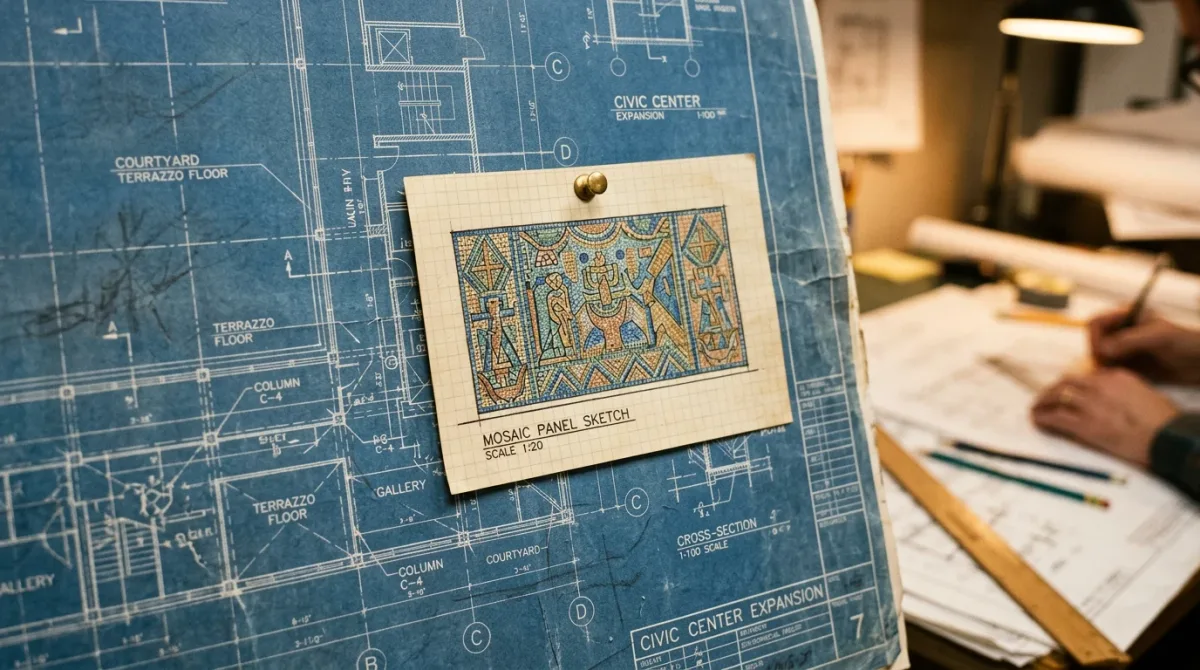
The medium is decided by the site. That solicitation specified that the finished design would be translated into roughly 1,000 square feet of mosaic by an approved fabricator, while stating that prior experience with the medium was not required. The selected artist produces final designs, selects a fabricator and oversees fabrication and installation, with project management support from the authority — which is why transit commissions reward artists comfortable with long production schedules and industrial processes.
How long does any of this take?
Longer than an exhibition cycle. Percent for Art panels convene at project initiation, and the artwork is delivered into a building that is itself being designed and constructed, so the commissioning clock is set by capital works rather than by the art calendar.
The programme's own early history gives a sense of the pace: administration began in 1983, the first artist selection panels met in 1984, and the first completed project followed in 1985, according to the city's description. Add the Public Design Commission's staged conceptual, preliminary and final reviews, and any amended submission required by a design change, and the interval between a panel's recommendation and a ribbon-cutting is measured in years. Artists weighing a public commission against gallery work should plan accordingly.
Practical details
- Programme: Percent for Art, New York City Department of Cultural Affairs. Directory submissions accepted on a rolling basis, no deadline. Enquiries: PercentInfo@culture.nyc.gov.
- Statutory formula: no less than one percent of the first $20m of eligible project budget, plus no less than one half of one percent above $20m; allocations capped at $400,000 per commission.
- Approvals: Public Design Commission review at conceptual, preliminary and final stages for artwork on city-owned property; sponsoring agency approval required first.
- Transit commissions: MTA Arts & Design, applications via open calls posted on Submittable; enquiries to arts@mtahq.org.
Figures, deadlines and application procedures are drawn from the city and authority pages cited above and are current as of publication; programme terms, budgets and submission windows are subject to change, and prospective applicants should confirm details against the relevant official page before applying.
For a related art perspective, read How a public artwork gets commissioned in New York.
For more context, read Art in Public Places: Tour & Artist Workshops.
For more context, read How to become a certified nursing assistant in New York.
For more context, read What it takes to become a registered nurse in New York.