
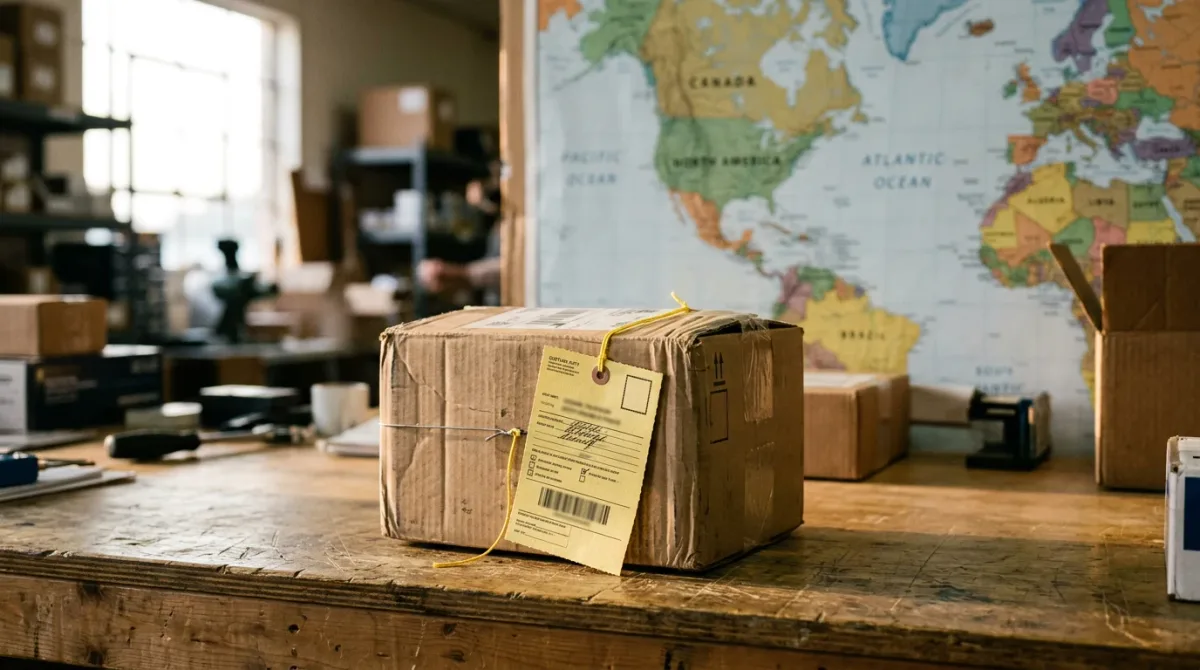
The United States eliminated duty-free treatment for low-value imports on Aug. 29, 2025, ending an exemption that had covered 1.36 billion packages a year, according to NPR. Every parcel entering the country now owes a tariff, calculated either as a share of its value or as a flat fee per package, per a Federal Register notice implementing the order.
What was the de minimis exemption?
"De minimis" let shipments under a set dollar value enter the U.S. without duties or a formal customs entry. The threshold started at $1 in the Tariff Act of 1930, and Congress raised it several times over the following decades. The most recent jump came in 2016, when the Trade Facilitation and Trade Enforcement Act lifted the cap to $800, according to NPR — among the highest de minimis thresholds of any major economy at the time.
That $800 ceiling, combined with the growth of direct-to-consumer shipping from overseas retailers, drove explosive volume. De minimis shipments grew from 140 million in 2014 to 1.36 billion in 2024, according to NPR, as platforms shipped individual orders straight from factories abroad instead of routing them through bulk, dutiable shipments.
A narrow set of shipments still avoids the new duties. Bona fide gifts valued under $100 and personal correspondence remain exempt, according to NPR. Everything else — from a $12 phone case to a $40 sweater ordered directly from an overseas seller — now generates a customs charge that didn't exist before Aug. 29, 2025.
Why did the exemption end?
President Trump signed Executive Order 14324 on July 30, 2025, suspending de minimis treatment "for all countries," effective Aug. 29, 2025 at 12:01 a.m. Eastern time for goods entered or withdrawn from a warehouse for consumption, according to the Federal Register notice implementing the order. China's de minimis access had already ended earlier in 2025 before the global suspension took effect, per Axios.
The order rests on the International Emergency Economic Powers Act, the National Emergencies Act, Section 604 of the Trade Act of 1974 and Section 301 of Title 3 of the U.S. Code, according to the Federal Register notice. It ties the suspension to national emergencies the administration had already declared over synthetic-opioid trafficking and trade deficits, rather than to a new, standalone finding about de minimis itself.
Roughly 1.3 billion parcels qualified for de minimis treatment in the year before the suspension, and about 60% of them originated in China, according to Axios — even after China's own de minimis access had already been cut off earlier in 2025. The volume explains why the transition rules focus so heavily on postal carriers: mail and small-parcel networks, not container ships, moved the bulk of the shipments the order now taxes.
How is the duty collected now?
Carriers handling international postal shipments got a choice between two collection methods during a six-month transition window, according to the Federal Register notice. The first applies the effective IEEPA tariff rate directly to a package's declared value. The second is a flat specific duty — $80, $160 or $200 per package — keyed to which tariff tier the country of origin falls into. Non-postal shipments, the kind moved by commercial freight forwarders and express carriers, must go through formal entry in CBP's Automated Commercial Environment instead of either flat-fee option.
The flat-fee option exists because ad valorem calculation is hard to do at postal-network scale: a postal worker sorting parcels has no easy way to verify a seller's declared value the way a customs broker filing a formal entry does. The specific-duty tiers let a postal operator apply one of three set dollar amounts based only on the shipment's country of origin, without pricing each item individually, according to the Federal Register notice.
| Shipment type | Duty method | How it's calculated |
|---|---|---|
| International postal (ad valorem option) | Percentage of value | Effective IEEPA tariff rate applied to the package's declared value |
| International postal (specific option, six-month window) | Flat fee | $80, $160 or $200 per package, based on the origin country's tariff tier |
| Commercial and freight-forwarded shipments | Formal customs entry | Filed through CBP's Automated Commercial Environment, no flat-fee option |
Who pays the duty first?
Carriers and postal operators remit the duty at the border, but the cost is generally built into the price the buyer pays or billed separately on delivery. At least 29 European postal services suspended U.S.-bound shipments after the rule took effect, along with several Asian and Latin American carriers, citing the compliance burden of the new paperwork, according to Axios. The administration projected the change would generate $10 billion in annual tariff revenue, per Axios — a government estimate, not an independent forecast.
The compliance burden fell hardest on small parcel operators. "Critical issues and processes, such as customs duties collection, the data to be collected, and the interaction with U.S. Customs and Border Protection, are not yet clearly defined," the European postal association PostEurop said, according to Axios. Items caught up in the shift ranged from imported yarn to cigars — goods with no obvious link to the drug-trafficking or trade-deficit emergencies cited as the order's legal basis, Axios reported. The European Union separately saw its own e-commerce parcel volume nearly double to roughly 4.6 billion shipments a year, per NPR, underscoring how much low-value cross-border shipping has grown industry-wide, not just into the U.S.
What changed most recently?
The suspension isn't a one-time action; the administration has renewed and adjusted it since August 2025. A Feb. 25, 2026 Federal Register notice describes a follow-on order, signed Feb. 24, 2026, that keeps the global suspension in place and folds postal shipments into the standard duty structure. Postal packages must now pay duties equal to the temporary import surcharge rate set in a Feb. 20, 2026 proclamation, rather than the flat-fee options carriers used during the initial transition, according to the notice. The Commerce Department had confirmed CBP's systems could handle postal-duty collection, which triggered the shift away from the interim flat fees.
For a related economy news perspective, read Ben Affleck and Matt Damon Make a Splash on Gossip Stone TV.
For more context, read How State Cellphone Ban Laws Actually Work in K-12 Schools.
For more context, read What it takes to become a registered nurse in New York.