

Both hormonal and copper IUDs work mainly by keeping sperm from reaching an egg, according to the CDC's 2024 U.S. Selected Practice Recommendations for Contraceptive Use. Hormonal IUDs also thicken cervical mucus and thin the uterine lining, while the copper IUD is toxic to sperm; typical-use failure rates for both types are under 1% a year.
An IUD, or intrauterine device, is a small T-shaped device a clinician places inside the uterus to prevent pregnancy. There are two broad categories available in the United States: hormonal IUDs, which release a low, steady dose of the hormone levonorgestrel, and a single copper IUD, which contains no hormones at all. Four IUDs are approved for use in the US: one copper device and three levonorgestrel devices at different doses, per the CDC's 2024 guidance.
How does a hormonal IUD work?
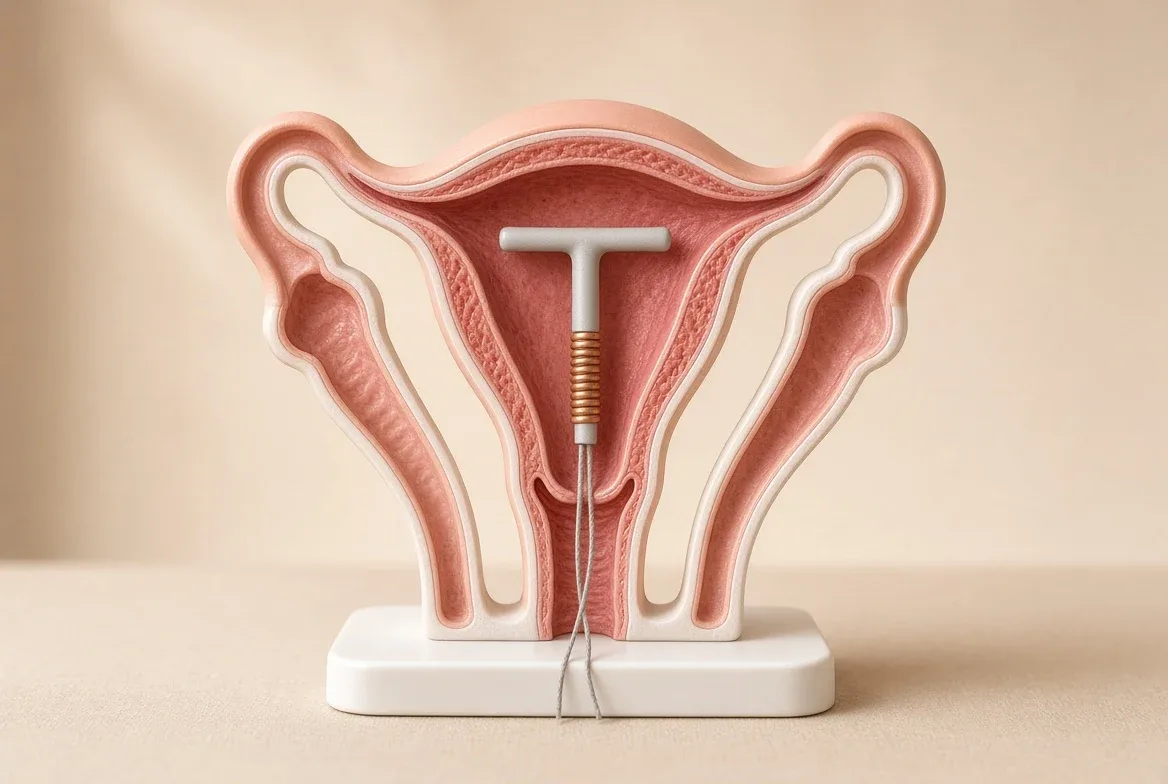
A hormonal IUD releases levonorgestrel directly into the uterus. According to Mayo Clinic's patient guidance on the levonorgestrel IUD sold as Mirena, the hormone thickens mucus in the cervix so sperm cannot easily reach an egg, thins the lining of the uterus, and partly suppresses ovulation. Together, these effects make fertilization and implantation unlikely.
Because the hormone acts mostly within the uterus, hormonal IUDs deliver a much lower dose systemically than birth control pills. Mirena is approved for up to eight years of use, per Mayo Clinic, though the exact approved duration varies by brand and dose — a reason to confirm the specific device's timeline with the clinician who places it.
How does the copper IUD work?
The copper IUD contains no hormones. Copper ions released inside the uterus are toxic to sperm and interfere with sperm movement, which is thought to be its main way of preventing fertilization, per the CDC's 2024 recommendations. It can also be placed as a form of emergency contraception: the CDC notes a copper IUD placed within five days of unprotected intercourse can prevent pregnancy, with no backup contraception needed afterward.
Unlike hormonal IUDs, the copper IUD does not suppress ovulation or thin the uterine lining through hormones. Some people choose it specifically because it avoids hormonal side effects, though it can mean heavier or longer periods, discussed further below.
How effective are IUDs compared with other methods?
IUDs are among the most effective reversible birth control methods available. The CDC's contraception overview, last reviewed in August 2024, lists the following typical-use failure rates — the percentage of users who become pregnant in a year of typical, real-world use:
| Method | Typical-use failure rate |
|---|---|
| Hormonal (levonorgestrel) IUD | 0.1%–0.4% |
| Contraceptive implant | 0.1% |
| Copper IUD | 0.8% |
| Vasectomy | 0.15% |
| Combined pill, patch, or vaginal ring | 7% |
| Injection (the shot) | 4% |
| Male condom | 13% |
| Fertility awareness methods | 2%–23% |
Fewer than one IUD user in 100 becomes pregnant in the first year of typical use, according to the CDC's 2024 recommendations for intrauterine contraception. That effectiveness does not depend on remembering a daily pill or a monthly ring change, which is part of why IUDs and implants are grouped together as long-acting reversible contraception.
What happens during IUD insertion?
Before placement, the CDC's 2024 guidance identifies a bimanual pelvic exam and a visual inspection of the cervix as the only essential steps. Other checks — blood pressure, weight, a breast exam, or lab work — are optional and left to clinical judgment; the guidance specifically states that placement should not be delayed to complete STI screening if a person hasn't been recently tested.
Timing depends on the device and the point in the menstrual cycle. A copper IUD can typically be placed at any time once pregnancy is reasonably ruled out, per the CDC, and needs no backup contraception afterward. A hormonal IUD placed within the first seven days of a period also needs no backup method; placed later in the cycle, the CDC recommends abstinence or a barrier method, such as condoms, for seven days while the device takes effect. People who are breastfeeding or recently gave birth have separate timing considerations the CDC guidance addresses directly with a clinician.
What side effects are common, and how long do they last?
Both IUD types commonly cause changes in bleeding, especially in the first few months. With the copper IUD, spotting or light bleeding is common in the first three to six months, according to the CDC's 2024 recommendations, which note that NSAIDs taken for five to seven days during a heavy or prolonged bleeding episode may help.
With hormonal IUDs, Mayo Clinic's patient guidance on Mirena describes irregular bleeding that tends to improve after about three months of use, along with possible headaches, acne, breast soreness, mood changes, and cramping or pelvic pain. Many users see their periods lighten substantially or stop: Mayo Clinic cites roughly 20% of users without periods after one year, while the CDC's 2024 recommendations put the share experiencing amenorrhea at about 50% by two years of use. The CDC notes that amenorrhea itself needs no treatment beyond reassurance, since it reflects the hormone's effect on the uterine lining rather than a problem to correct.
When to talk to a clinician
Mayo Clinic's patient guidance on hormonal IUDs advises contacting a clinician promptly for: signs of possible pregnancy; abnormal vaginal bleeding or discharge outside the expected adjustment period; pelvic or sexual pain; fever or other signs of infection; severe headaches or migraines; or an inability to feel the device's strings, or feeling the device itself. Any of these can signal expulsion, a rare uterine perforation, infection, or, if pregnancy does occur, an increased risk of ectopic pregnancy — all reasons a clinician needs to examine the situation directly rather than being managed at home. This article describes how IUDs work in general; it is not a substitute for a personal evaluation, and anyone with questions about symptoms or which method fits their health history should talk with their own clinician.
Frequently asked questions
How long does a hormonal IUD last?
It depends on the specific device and dose. Mirena, one of the levonorgestrel IUDs available in the US, is approved for up to eight years, according to Mayo Clinic. Other hormonal IUD brands and doses carry different approved durations, so the timeline is worth confirming with the clinician who places it.
Can an IUD be used as emergency contraception?
Yes, for the copper IUD. The CDC's 2024 recommendations note that placing a copper IUD within five days of unprotected intercourse can prevent pregnancy, and no backup method is needed afterward. This use applies specifically to the copper device, not hormonal IUDs.
Does an IUD protect against STIs?
No. Mayo Clinic's patient guidance on hormonal IUDs states plainly that the device does not protect against sexually transmitted infections, so barrier methods like condoms are still needed for STI prevention regardless of IUD use.
What if I can't feel the IUD strings anymore?
Mayo Clinic's guidance lists this among the reasons to contact a clinician promptly, since it can indicate the device has shifted or been expelled. A clinician can check placement, generally without needing to remove and replace the device unless it has actually moved.
How effective are IUDs compared with the pill?
IUDs are considerably more effective in typical use. The CDC's 2024 data put the typical-use failure rate at 0.1%–0.4% for hormonal IUDs and 0.8% for the copper IUD, compared with about 7% for combined birth control pills, largely because IUD effectiveness doesn't depend on remembering a daily dose.
For a related reproductive perspective, read “A keto diet can help manage polycystic ovary syndrome (PCOS) in women”.
For more context, read Complete Guide to Building a Sustainable Wellness Routine.
For more context, read What actually happens during perimenopause?.
For more context, read Why Your Hair Is Suddenly Shedding More (And When It Stops).