
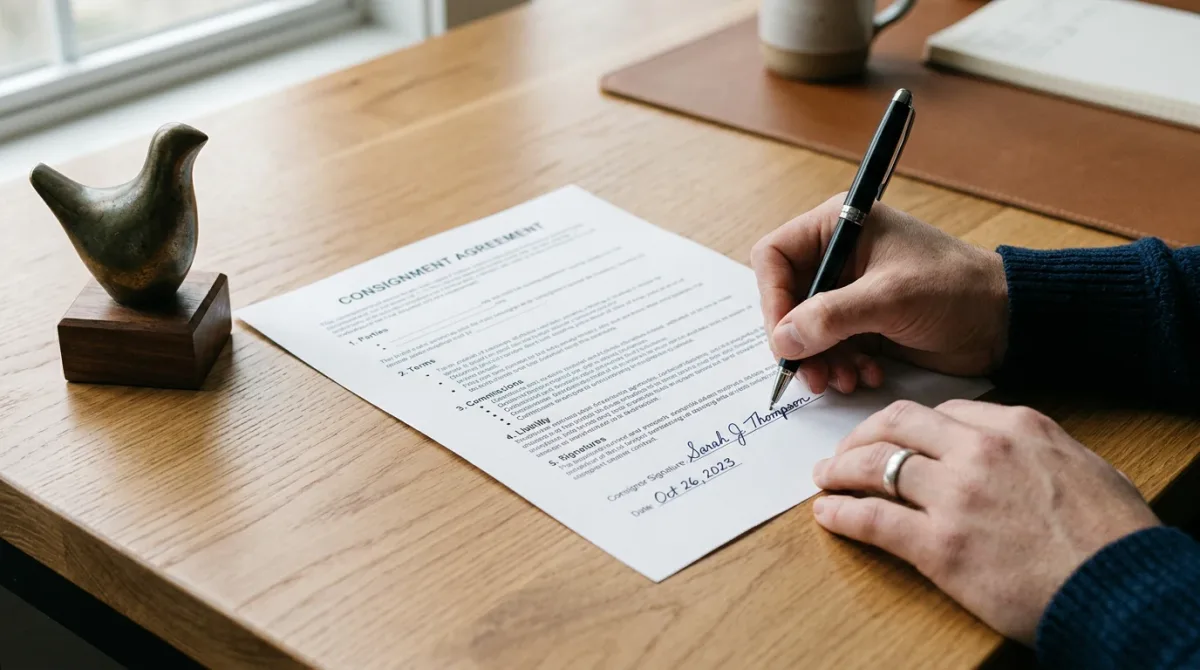
Most galleries keep between 30 and 60 percent of an artwork's sale price, with an even 50/50 split the most commonly cited industry norm, according to Fine Art Trade Guild figures reported by Artnet News. The rest goes to the artist, and in New York the proceeds are legally classified as trust funds the gallery must hold for the artist's benefit until it pays out, not general business revenue the gallery can spend.
That distinction between a percentage and a legal status is the part most collectors and even some emerging artists misunderstand about how a gallery relationship works. The commission split gets the attention; the consignment structure underneath it is what actually protects, or fails to protect, the money.
What is the standard commission split between a gallery and an artist?
The most frequently cited figure is a 50/50 split of the sale price, though the Fine Art Trade Guild's own range runs from 30 percent to 60 percent retained by the dealer, Artnet News reported, citing gallerist Stacie McCormick's account of a 60/40 split unfavorable to the artist on a body of work she had funded herself. There is no single legally mandated rate. The percentage is a negotiated contract term, not a market standard set by any regulator.
Where a work sells through the gallery's own network versus a studio visit the gallery arranged, or where the gallery has fronted production or shipping costs, the split can shift within a single relationship. That variability is exactly why art-law practitioners writing for the Center for Art Law have argued written contracts matter more in this business than a handshake percentage, since undocumented terms are the recurring source of later disputes over who owes what.
What does "exclusive representation" actually mean?
Exclusive representation means the artist has agreed the gallery is the only venue authorized to sell that artist's work, typically within a defined geographic territory or category of work, rather than a blanket claim on everything the artist makes. Non-exclusive arrangements, where an artist works with several galleries at once, have become more common as artists seek broader market access, The Art Newspaper reported.
Attorney Azmina Jasani, a partner in the Art & Cultural Property Law Group at Constantine Cannon, has written that confusion over exclusivity is one of the three recurring flashpoints in artist-gallery disputes, alongside late payment and the terms of an eventual split. In one case she described, a gallery and artist operated under exclusive consignment agreements applied inconsistently across individual works, leaving both sides unclear on which pieces the exclusivity actually covered.
What legally happens to the money after a sale?
In New York, the moment an artist delivers work to a gallery for sale, state law automatically creates a consignor-consignee relationship, and both the artwork and any proceeds from its sale become trust property held by the gallery for the artist's benefit, under Section 12.01 of the New York Arts and Cultural Affairs Law. That status holds even if the gallery itself buys the piece, until the artist is paid in full.
The practical effect is that if a gallery becomes insolvent, its general creditors cannot claim consigned artwork or the proceeds from its sale, because that money was never the gallery's property to begin with. The law does allow artists to waive some of these protections in a clear, written, and conspicuous agreement, but the waiver cannot apply to the artist's first $2,500 in annual gross proceeds, nor to work the gallery purchased after initially taking it on consignment. Not every state has an equivalent statute, and terms vary by jurisdiction, so the specific protection an artist has depends on where the consignment agreement is governed.
What happens when an artist and a gallery split up?
Disputes tend to concentrate on the same handful of issues: unpaid or delayed proceeds, unclear inventory records of which works the gallery still holds, and vague or absent language about how the relationship ends. Jasani has described cases involving multi-million-dollar sales where substantial sums went unpaid to the artist for months, underscoring why accounting and payment-timing clauses carry as much weight in these contracts as the commission percentage itself.
Legal commentators writing for the Center for Art Law have pointed to a defined exit process, covering return of unsold inventory, final accounting, and treatment of existing marketing materials, as a standard element attorneys recommend including at the outset of a gallery relationship rather than negotiating after a split has already turned contentious.
Why doesn't a percentage alone protect an artist?
A commission rate answers only how a completed sale is divided; it says nothing about when the gallery must pay, how sold and unsold inventory is tracked, or what happens if the gallery closes, is sued, or simply stops responding. Those questions are addressed, if at all, by the underlying consignment agreement and, in states like New York, by statute rather than by market custom.
That is the gap attorneys who work in this area consistently flag: an artist can have a favorable split on paper and still have no enforceable claim to unsold work or unpaid proceeds if the contract never specified consignment terms, inventory procedures, or an accounting schedule.
Why does an artist's home state or the gallery's location matter?
New York's trust-fund treatment of consigned art is a state statute, not a nationwide standard, and consignment protections vary from one state to another. An artist working with a gallery based outside New York, or a New York artist consigning work to an out-of-state gallery, cannot assume the same automatic trustee protections apply.
That variation is one reason attorneys writing for the Center for Art Law have pushed artists to confirm, in writing, which state's law governs a consignment agreement, rather than assuming the strongest available protections travel with the artwork. A contract silent on governing law leaves that question open precisely when it matters most, during a dispute over unpaid proceeds or a gallery's closure.
Frequently Asked Questions
What percentage do galleries usually take from an art sale?
Reported figures range from 30 to 60 percent retained by the gallery, with a 50/50 split most commonly cited as the industry norm, according to Fine Art Trade Guild data reported by Artnet News. The exact rate is set by individual contract, not by any regulator or trade requirement.
Is consigned art or its sale proceeds legally protected from a gallery's creditors in New York?
Yes. Under New York Arts and Cultural Affairs Law Section 12.01, consigned artwork and any proceeds from its sale are trust property held for the artist's benefit, and cannot be claimed by the gallery's general creditors, even if the gallery becomes insolvent.
Can an artist waive these New York consignment protections?
Only through a clear, conspicuous written waiver, and even then the law bars waiving protection over the artist's first $2,500 in gross annual proceeds or over work the gallery purchased after first taking it on consignment, under Section 12.01.
Can an artist show work with more than one gallery at the same time?
It depends entirely on the exclusivity terms in that artist's contract. Exclusive agreements limit sales to one gallery within an agreed territory or category, while non-exclusive arrangements, which The Art Newspaper reports have become more common, allow representation by several galleries at once.
What are the most common causes of artist-gallery disputes?
Attorney Azmina Jasani has identified late or unpaid proceeds, confusion over exclusivity terms, and unclear termination provisions as the recurring flashpoints, based on case studies involving disputes over payment and relationship endings.
For a related artists perspective, read How Gallery Representation Actually Works, From the 50/50 Split to Shared Rosters.
For more context, read Complete Guide to Building a Sustainable Wellness Routine.
For more context, read comic artwork quality.
For more context, read Why FERPA's vendor exception decides what ed-tech can access.