
Two federal programs cover most home accessibility modifications for older adults and veterans: the USDA's Section 504 program offers up to $10,000 in grants (plus a $40,000 loan option) to eligible rural homeowners age 62 and older, per Rural Development, while the VA's HISA grant caps out at $6,800 or $2,000 depending on disability status, per the VA Prosthetic and Sensory Aids Service. Eligibility and funding limits vary by program, location, and individual circumstances. This article is informational, not financial, legal, or medical advice — confirm current rules and your eligibility directly with the agency before you apply.
What Is the USDA Section 504 Home Repair Program?
Section 504 is a federal program for very-low-income homeowners in eligible rural areas who need to remove health and safety hazards from their home, including some accessibility barriers, according to USDA Rural Development (SRC-01).
The program has two parts, and they work differently:
- Grants are available only to homeowners age 62 or older and must be used specifically to remove health and safety hazards. The maximum lifetime grant is $10,000, rising to $15,000 in presidentially declared disaster areas (SRC-01).
- Loans are open to a broader range of very-low-income homeowners and can be used more flexibly, to repair, improve, or modernize a home. The maximum loan is $40,000, fixed at 1% interest with a 20-year term (SRC-01).
A household that qualifies for both can combine them for up to $50,000 in total assistance ($55,000 in disaster areas), per Rural Development (SRC-01). Applicants must own and occupy the home, meet their county's very-low-income limit, and be unable to get affordable credit elsewhere (SRC-01). Because this program is administered county by county through USDA Rural Development field offices, availability, processing time, and exact income cutoffs vary by location — check with your local office before you plan a budget around it.
How Much Can I Get From the VA HISA Grant?
The Department of Veterans Affairs' Home Improvements and Structural Alterations (HISA) grant pays for medically necessary home modifications tied to a veteran's disability, according to the VA Prosthetic and Sensory Aids Service (SRC-02). Unlike Section 504, HISA is a lifetime benefit cap, not an annual one, and the amount depends on your disability status:
- $6,800 lifetime maximum for veterans with a service-connected disability, a condition treated "as if" service-connected through VA care, or a non-service-connected disability combined with a service-connected rating of 50% or more (SRC-02).
- $2,000 lifetime maximum for other eligible disabilities not covered above (SRC-02).
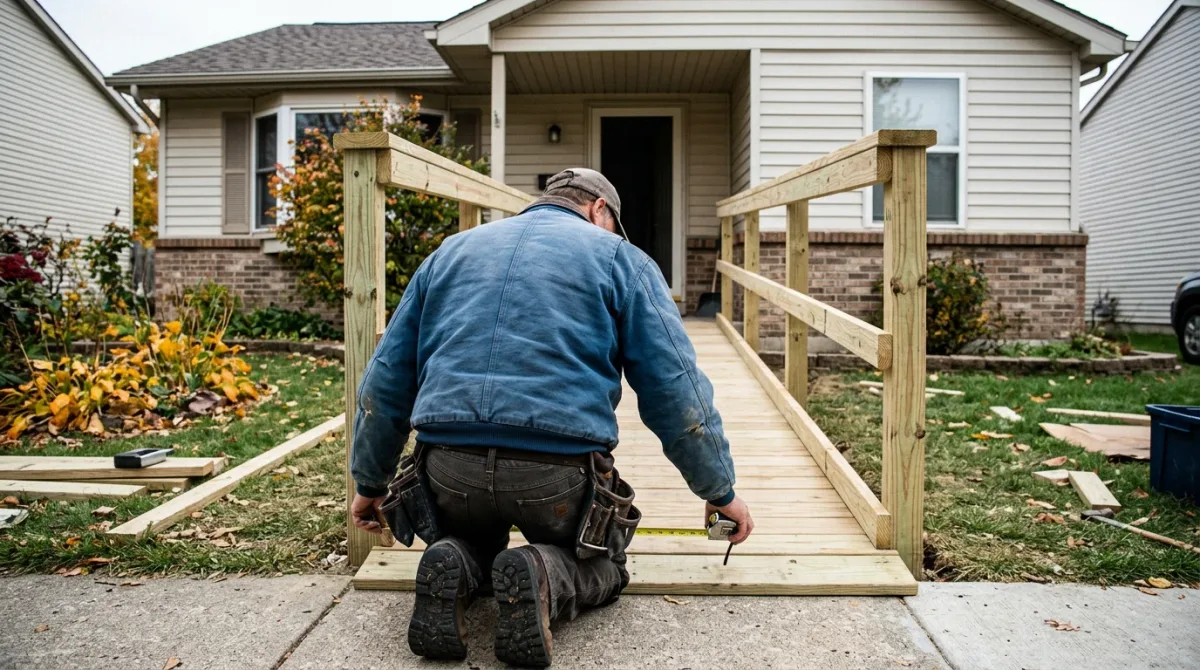
Approved uses include widening entrances, building permanent ramps, installing roll-in showers or lowered bathroom fixtures, kitchen accessibility changes, and electrical or plumbing work needed to run medical equipment (SRC-02). HISA does not cover exterior decking, spas or hot tubs, walkways to detached buildings, new construction, or routine maintenance (SRC-02). Every project has to be shown to be medically necessary, so the process typically starts with your VA prescribing clinician, not a contractor. Contact your local VA Prosthetic and Sensory Aids Service office to confirm your remaining lifetime benefit before you commit to a project, since prior use of the grant reduces what's left.
Are There Other Ways to Fund Accessibility Modifications?
Section 504 and HISA are the two federal programs with clear, published dollar figures, but they're not the only doors to try. Many states run Medicaid Home and Community-Based Services (HCBS) waiver programs that can help pay for home modifications as an alternative to institutional care, and local Area Agencies on Aging often maintain lists of state, county, or nonprofit repair funds. Rules, waitlists, and covered items differ significantly by state and by waiver, so information-not-advice applies here too: treat this as a starting point for your own research, not a promise of funding, and confirm current terms with your state Medicaid office or local Area Agency on Aging before counting on any specific amount.
What Doorway and Turning-Space Sizes Should I Plan For?
Whichever funding source you use, it helps to know the dimensions contractors and inspectors typically measure against. The ADA Standards for Accessible Design, maintained by the Department of Justice, set a minimum clear doorway width of 32 inches at a single point and 36 inches for continuous passage along an accessible route, plus a wheelchair turning space of either a 60-inch-diameter circle or a T-shaped clearance (SRC-03).
One qualification is important: the ADA standards technically govern public accommodations and commercial facilities, not private single-family homes. A private residence isn't legally required to meet them. But because they're the most detailed published wheelchair-clearance figures available, contractors, accessibility consultants, and manufacturers commonly use them as reference targets for private home remodels too. Separately, the Fair Housing Act's design requirements apply to certain multifamily housing built for first occupancy after March 1991 — a different law, covering different buildings, with its own rules. If you live in a condo, co-op, or multifamily rental and want to know which standard actually applies to your unit, ask your property manager or a local fair housing agency rather than assuming.
How Do I Apply, Step by Step?
- Identify which programs you may qualify for. Section 504 requires a rural address and very-low income; HISA requires a service-connected or VA-recognized disability.
- Get documentation lined up early. Section 504 applications need proof of income, age, and homeownership; HISA applications need a medical justification from a VA clinician tying the modification to your disability.
- Contact the right office directly. For Section 504, that's your USDA Rural Development state or county office. For HISA, that's your local VA Prosthetic and Sensory Aids Service.
- Ask what's already been used. HISA's cap is lifetime, so ask the VA office how much of your $6,800 or $2,000 benefit remains before you plan a project around it.
- Get contractor bids only after funding is confirmed. Both programs require specific paperwork and, in some cases, pre-approval before work begins — starting construction first can put reimbursement at risk.
- Ask about combining sources. A Section 504 grant and loan can be combined; ask your Area Agency on Aging whether a state or nonprofit fund can cover a gap either program leaves.
Accessibility Funding at a Glance
| Program | Who it's for | Maximum amount | Cap type |
|---|---|---|---|
| USDA Section 504 Grant | Very-low-income rural homeowners, age 62+ | $10,000 ($15,000 in disaster areas) | Lifetime |
| USDA Section 504 Loan | Very-low-income rural homeowners | $40,000 at 1% fixed, 20-year term | Per loan |
| VA HISA (higher tier) | Veterans with service-connected or 50%+ combined rating | $6,800 | Lifetime |
| VA HISA (standard tier) | Veterans with other eligible disabilities | $2,000 | Lifetime |
Note: figures and eligibility rules vary by program administrator, county, and individual case; confirm current amounts directly with USDA Rural Development or your local VA Prosthetic and Sensory Aids Service office before budgeting.
Frequently Asked Questions
Can I use both a USDA Section 504 grant and a VA HISA grant on the same project?
There's no federal rule against using both if you qualify for each on its own terms, but they have different eligibility paths (income and age for Section 504, service-connected disability for HISA). Confirm with each program office how they'd treat combined funding on one project.
Does the HISA grant renew every year?
No. Per the VA Prosthetic and Sensory Aids Service, the $6,800 and $2,000 amounts are lifetime maximums, not annual benefits (SRC-02). Once you've used your full amount, it does not reset.
Do I have to live in a rural area to qualify for Section 504?
Yes. Section 504 is administered by USDA Rural Development and is limited to eligible rural areas as defined by USDA; homes in most cities and larger suburbs don't qualify (SRC-01).
Is a private home legally required to meet ADA doorway widths?
No. The ADA Standards for Accessible Design apply to public accommodations and commercial facilities, not private single-family homes (SRC-03). They're widely used as a reference benchmark, but a private residence isn't legally bound by them.
What if I don't qualify for either program?
Ask your local Area Agency on Aging about state, county, or nonprofit home-repair funds, and ask your state Medicaid office about Home and Community-Based Services waivers — availability and rules vary widely by state.
For a related housing perspective, read Who Pays for Home Modifications: VA Grants, USDA Repair Money, and Medicaid Waivers.
For more context, read Complete Guide to Building a Sustainable Wellness Routine.