
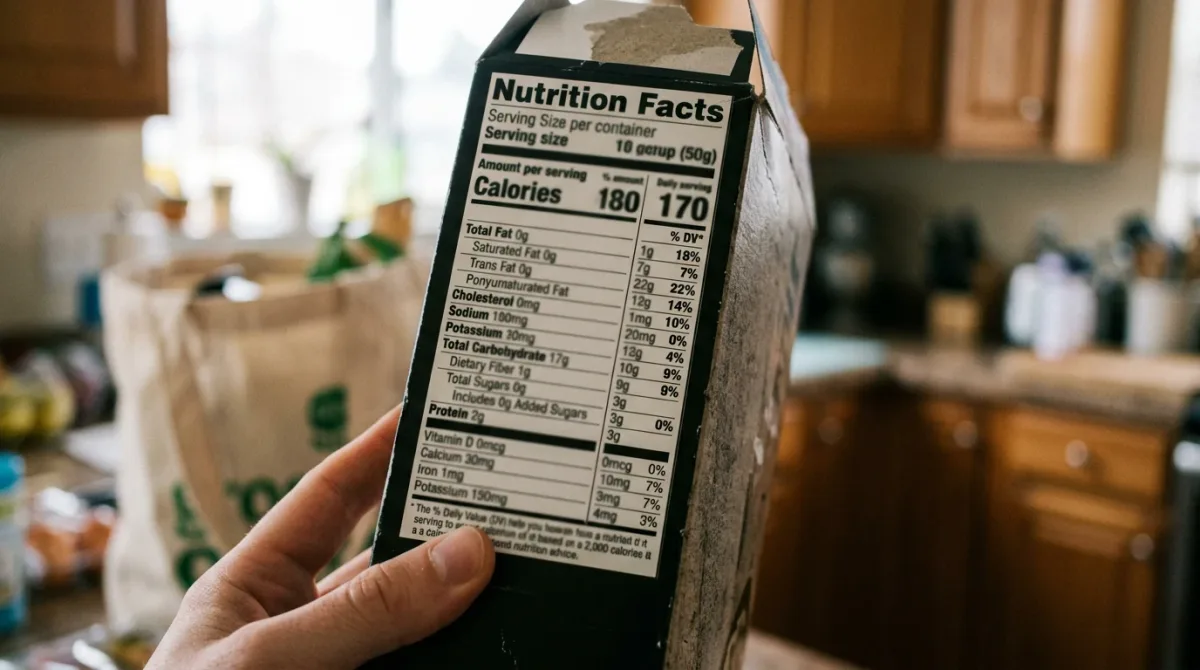
The percent Daily Value (%DV) on a Nutrition Facts label shows how much of a nutrient one serving contributes against a 2,000-calorie reference diet, using a threshold the FDA sets at 5% DV or less for "low" and 20% DV or more for "high" — a rule that applies to added sugars too, which carry a 50-gram Daily Value, according to the FDA's nutrition label guidance.
That single number next to each nutrient looks like a simple percentage, but it is doing a specific calculation, built around a specific reference amount, that most shoppers never see spelled out.
How is %DV actually calculated?
The FDA defines %DV as the percentage of a nutrient's daily reference amount supplied by one labeled serving of the food, according to the agency's guidance on understanding and using the Nutrition Facts label. For a nutrient with a 50-gram Daily Value, a serving containing 7 grams works out to 14% DV — 7 divided by 50, according to the FDA's added-sugars labeling page, which uses that exact figure as its worked example.
Each nutrient on the label has its own separate reference amount, set by the FDA and unrelated to the reference amounts for other nutrients on the same label. That is why the %DV figures printed in one column do not add up to 100% — sodium's %DV is calculated against sodium's own daily reference, fat's against fat's, and so on, independent of every other line, per the FDA's guidance.
What's the Daily Value for added sugars, and why is it on the label?
The FDA set the Daily Value for added sugars at 50 grams, based on a 2,000-calorie diet, when it added a dedicated added-sugars line to the Nutrition Facts label as part of the 2016 label overhaul — the first major redesign of the label in more than two decades, according to the FDA's summary of what changed. The line sits directly beneath total sugars and is prefaced with "Includes," showing added sugars as a subset of the sugars already counted in that total rather than a separate figure layered on top, per the FDA's added-sugars guidance.
The agency added the line because, in its own language, "consuming too much added sugars can make it hard to meet nutrient needs while staying within calorie limits" — a framing about crowding out other nutrients within a fixed calorie budget, not a claim about a single ingredient being dangerous, according to the FDA's summary of the label update.
How do the 5% and 20% thresholds work in practice?
The FDA's rule of thumb applies the same way to every nutrient on the label: 5% DV or less per serving counts as low, and 20% DV or more counts as high, according to the agency's label-reading guidance. Applied to added sugars, a serving at 14% DV — the FDA's own example — sits in between: not low, not yet at the high threshold. A shopper comparing two cereals can use the same 5-and-20 scale for added sugars that they would for saturated fat or sodium, without needing to remember a different rule for each nutrient.
Do serving sizes change what the %DV actually means?
The %DV is always calculated per labeled serving, and the FDA's 2016 update revised serving sizes on many products to better reflect amounts people actually eat in one sitting, rather than smaller reference amounts used previously, according to the agency's summary of the changes. A package that contains more than one labeled serving still lists %DV per serving, not per container, so a snack eaten as "one serving" that is actually two servings' worth doubles the added-sugars %DV a person actually consumes. Checking the servings-per-container line above the serving-size line catches this before totaling up a day's intake, a distinction the consumer-nutrition site Healthline highlights in its guidance on reading food labels.
Where do added sugars hide in the ingredient list?
Because added sugars can appear under dozens of different names — syrups, cane sugar, fruit juice concentrate, and other sweeteners among them — a product can carry meaningful added sugar without any single sugar-named ingredient appearing near the top of the ingredient list, according to Healthline's guide to reading food labels. The %DV line for added sugars on the Nutrition Facts panel captures all of those sources added together into one figure, regardless of which specific sweetener name appears in the ingredients.
When to talk to a clinician
The Daily Value of 50 grams is a general reference figure for a 2,000-calorie diet, not an individualized target, and the FDA's guidance does not set a personal limit for any one reader. People managing diabetes, weight, dental health, or other conditions where sugar intake is a factor should work out an appropriate daily target with a clinician or registered dietitian rather than applying the label's 50-gram reference directly; this article describes how the label's math works and is not medical advice.
For a related workplace perspective, read New York's ICU nurse-staffing rule is four years old. Hospitals still miss it more than half the time, union data show.
For more context, read Complete Guide to Building a Sustainable Wellness Routine.
For more context, read how to read a sunscreen label without getting played.
For more context, read What the SPF Number on Your Sunscreen Label Actually Means.