
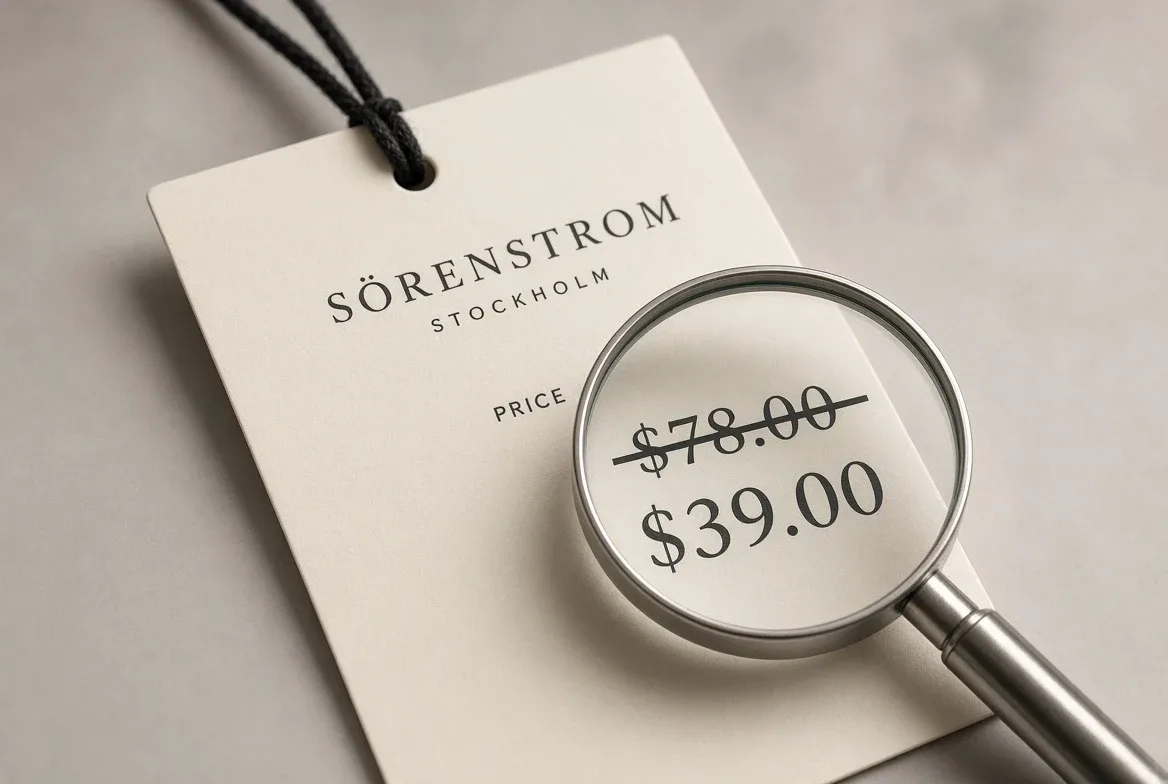
A struck-through "was" price is a claim about what one seller recently charged — not a fact about what an item is worth. Federal advertising guidance says that comparison only holds up when the higher number is a real, recent, regular price. Checking it takes about two minutes, and the check is the same every time.
What is a "was" price actually claiming?
It claims the same store recently sold the same item at the higher number. That is the standard set out in the Federal Trade Commission's Guides Against Deceptive Pricing, which state that a former price works as a basis for a bargain claim when it is "the actual, bona fide price at which the article was offered to the public on a regular basis for a reasonably substantial period of time."
The guides describe the failure mode just as plainly. Where "the former price being advertised is not bona fide but fictitious," the text says, "the 'bargain' being advertised is a false one." The burden sits with the advertiser: the guides say the seller should be careful that the price is one at which the product was "openly and actively offered for sale, for a reasonably substantial period of time, in the recent, regular course of his business."
Two things follow for you as a shopper. A "was" price attached to an item that has sat at the sale price since it launched is not describing a markdown. And a percentage calculated from that number is arithmetic on a figure you cannot see.
One boundary worth stating: these are FTC guides about advertising practice in general. Whether any particular retailer's pricing complies with them is a legal question, and it is not one this desk answers.
Is "compare at" the same claim as "was"?
No, and the difference matters. A former-price claim points at the same seller's own past price. A "compare at" or "comparable value" figure points at other merchandise somewhere else, which is a different assertion with a different condition attached.
The FTC guides say that kind of advertising "can serve a useful and legitimate purpose when it is made clear to the consumer that a comparison is being made with other merchandise and the other merchandise is, in fact, of essentially similar quality." Essentially similar quality is doing the work in that sentence. If the comparison garment is a different make, a different fabric weight, or a different season's cut, the number is describing something you are not buying.
Manufacturer list prices get a third treatment. The guides say a list price "will not be deemed fictitious if it is the price at which substantial (that is, not isolated or insignificant) sales are made in the advertiser's trade area" — substantial meaning, in the guides' own gloss, not isolated or insignificant. So a list price only anchors anything if items actually sell at it near you.
When you look at a tag, read the label on the higher number before you read the number. "Was," "originally," "compare at," and "suggested retail" are four different claims wearing similar type.
Does the fine print fix a misleading sale claim?
Not on its own. The FTC's advertising guidance for small businesses says that "the same standards for truthfulness apply when companies make claims about price comparisons, 'sale' prices, and the like," and that advertisers cannot "use fine print to contradict other statements in an ad or to clear up misimpressions that the ad would leave otherwise."
The same guidance tells advertisers to "use clear and unambiguous language, place any qualifying information close to the claim being qualified, and avoid using small type or any distracting elements." Read that from the shopper's side and it becomes a practical tell: a discount whose meaning only survives a footnote at the bottom of the page is a discount worth reading twice.
What no source here establishes is any individual retailer's price history for any individual item. Policy pages describe process. They do not tell you what a coat cost in March.
How do you check a "was" price before you commit?
Five steps, in order, and none of them require a subscription.
- Write down the current price and the date you saw it. Everything else is a comparison against that pair, and a price without a date is not evidence.
- Read the label on the higher number. A former-price claim and a "compare at" claim are held to different conditions under the FTC guides, as above.
- Find the identical item elsewhere — and be strict about identical. Target's policy defines the match as "the identical item, brand name, size, weight, color, quantity and model number," which is a usefully unforgiving bar to borrow.
- Check the price-adjustment window at that retailer before you pay, not after. The windows are short and they differ.
- Keep the dated receipt. Kohl's requires the original, dated sales receipt for an adjustment, and most policies assume you can produce proof of what you paid and when.
What happens if the price drops right after you buy?
Several large retailers publish a window in which they will refund the difference, and the windows are measured in days, not months. Here is what three of them say on their own policy pages, checked August 20, 2026. Policies change without notice, so confirm the current terms on the retailer's page before you rely on any of this.
| Retailer | Stated window | Notable exclusions |
|---|---|---|
| Kohl's | Price lower than what you paid "in the prior two weeks" | Clearance markdowns, Kohl's Cares merchandise, BOGO promotions; original dated receipt required |
| Nordstrom | "within 10 days of your shipment date" | "Designer items purchased on sale are excluded from price adjustments" |
| Target | "at time of purchase or within 14 days after purchase" | Clearance, closeout, liquidation, damaged, used, open package or refurbished items |
Kohl's price adjustment policy ties the request to the sale or regular price you paid in that prior two-week period, and routes in-store purchases to the store and online purchases to customer service. Nordstrom's pricing policy sets its window from the shipment date and also lists the competitors it will match against, requiring that the item be identical in color and size and in stock at both sellers. Target's price match policy runs 14 days and carves out clearance and closeout stock along with pre-orders and several service categories.
Note the pattern in the exclusions. Clearance is the category most often left out, which is the same category that carries the largest advertised percentages. The deepest discount and the weakest backstop tend to arrive together.
Who should skip this exercise?
If the item costs less than the value of ten minutes of your time, skip it and buy the thing. The check earns its keep on coats, boots, bags, and beauty sets — purchases where a two-week price move is worth real money and where a return window may matter more than the discount.
Skip it too when you are buying clearance you actually want. The adjustment policies above generally exclude clearance, so there is no refund path behind the purchase; the only question left is whether the current price alone is worth paying, independent of any struck-through number beside it.
And skip the percentage entirely when the higher number is a "compare at" figure with no named comparison item. There is nothing to verify. Judge the price you would actually pay against what the same item costs at other sellers today, and let the tag keep its own arithmetic.
For a related value perspective, read How to tell if that “was” price is actually real.
For more context, read Complete Guide to Building a Sustainable Wellness Routine.
For more context, read health insurance basics.
For more context, read What Dollar-Cost Averaging Means and How It Works.