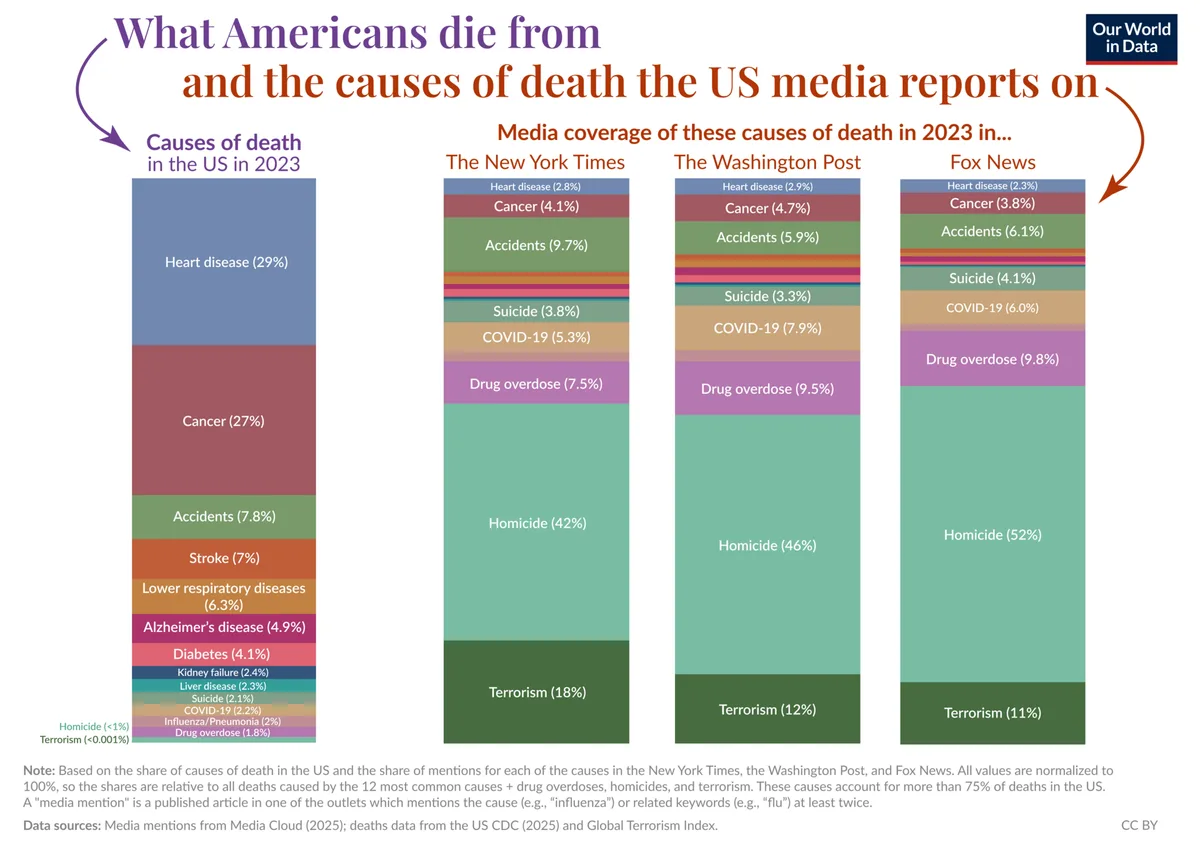
Reading health news well means treating every headline as a summary of a summary. Merriam-Webster defines "read" not just as taking in words but as interpreting them — attributing a meaning to a passage, sometimes a meaning the words do not actually carry. That is the exact risk with health headlines: the study underneath usually says something narrower than the sentence above it.
The most common gap is between "associated with" and "causes." A study that finds two things happen together has not shown that one makes the other happen. A headline that swaps one word for the other turns a careful statistical observation into a behavior recommendation nobody actually made. When a headline says coffee, eggs, screen time, or any daily habit raises or lowers a risk, the first question is whether the underlying research was an experiment or an observation.
This guide walks through the checks that separate solid health reporting from overstated framing. It is general media literacy, not medical advice; decisions about screening, treatment, or medication belong with a clinician who knows the reader's history. For coverage built on these habits, see the publication's health news section.
What kind of study is underneath the headline?
The study type sets the ceiling on what the headline can honestly claim. A randomized controlled trial assigns people to groups by chance, which is the strongest design for testing whether a treatment causes an effect. Observational studies — cohorts, case-control comparisons, surveys — watch what people already do and look for patterns. Patterns can be distorted by confounders: people who take a supplement may also eat better, exercise more, and see doctors more often, and the study may not fully adjust for that.
Animal and laboratory studies sit lower still. A compound shrank a tumor in mice is a real finding and a long way from a human therapy. Headlines rarely carry these labels, so the reader has to look for them in the body of the story or the abstract of the study itself. If a story never says what kind of study it covers, that omission is itself information.
Who paid for it, and who benefits from the framing?
Funding does not make a finding false, but it shapes what gets studied, what gets published, and which result reaches the press release. Industry-funded trials of a sponsor's own product deserve the same scrutiny as any trial, plus one extra question: would this result sell something? The same applies to press releases from institutions whose hospitals, patents, or licensing deals stand to gain.
A practical habit is to check the disclosure section of the study, usually near the end of the abstract or the paper's final page. Look for named companies, and look for the word "employees." A result reported by researchers who hold equity in the compound is still evidence — it is just evidence with an interested party attached, and the story should say so. When coverage of a hospital deal or a labor dispute involves parties with obvious stakes, the same rule holds: an employer's figure is an employer's figure, a union's figure is a union's figure. The Maimonides and NYC Health + Hospitals merger coverage is one example of claims that need that labeling. This connects to our earlier piece, Brooklyn's Maimonides moves to join NYC Health + Hospitals in a $2.2 billion New York hospital merger.
Is the number doing real work, or just decoration?
Relative risk and absolute risk are different statements, and headlines almost always pick the bigger-sounding one. If a condition affects 2 people in 10,000 and a factor doubles the risk, the honest framing is: 2 in 10,000 becomes 4 in 10,000. "Doubles your risk" and "adds 2 cases per 10,000 people" describe the same finding. The first sells; the second informs.
Watch for three more number traps:
- No denominator. "Cases surged 40%" means little without the starting count. A rise from 10 cases to 14 is a 40% increase.
- Surrogate endpoints. A drug that lowers a blood marker has not yet been shown to prevent the disease the marker is associated with.
- Subgroup fishing. A benefit that appears only in one slice of the study population — say, women over 70 who also exercised — may be a statistical fluke found after the fact, not a planned analysis.
When a story cites a specific figure, note whose number it is. Federal labor statistics, association surveys, and single-hospital counts carry different weights, and reporting that blurs them is doing the reader a disservice. Workforce stories such as the federal estimate of work fatigue costs show the difference between a named federal source and an advocacy estimate. Readers following this should also see Work fatigue costs employers $218 billion a year, and health care carries outsized risk, federal data show.
What did the headline leave out?
Most study headlines omit the same four things: the sample size, the study duration, whether the finding held after adjustment, and whether the result was replicated. Small, short, unadjusted, and unreplicated are all reasons for calm. A single study is one data point; fields move by accumulation, and early findings often shrink or reverse when larger studies run.
The Cambridge Dictionary's entry on "read" includes a second sense worth borrowing: to interpret, as in reading a situation to anticipate what happens next. Applied to health news, that means reading past the headline to ask what would have to be true for the claim to hold. If the answer is "a promising result in a petri dish," the honest response is interest, not action.
Two structural checks finish the job. First, find the actual study: a good story links or names it, with journal and year. If it cannot be found, treat the claim as unconfirmed. Second, look for independent expert reaction — a researcher with no role in the study, quoted on its limits. Coverage without any outside voice is more likely to be a press release in disguise.
What this means for readers, step by step
Our analysis of how overstated health stories spread suggests the failure point is usually the first ten seconds, when a headline is shared before the article is read. A short routine closes most of that gap:
- Read past the headline. Confirm the story says what the headline implies.
- Identify the study type: trial, observational, animal, or lab.
- Find the funding and conflict disclosures.
- Convert any relative-risk claim to absolute terms, or note that the story did not.
- Check for independent expert comment and a link to the actual research.
- Before acting on a finding, ask a clinician — headlines are not dosing instructions, and this publication does not give medical advice.
None of this turns a reader into a statistician. It turns a reader into someone who knows which questions a story should have answered — and who notices when it dodged them. The same discipline applies beyond studies: coverage of policy fights, staffing rules, and budget moves rewards readers who track whose claim each number is. The safe-staffing debate in Albany, like any advocacy-heavy story, reads differently once each side's figures are labeled as that side's.
Where to go from here
Media literacy in health news is a habit, not a test. The checks above — study type, funding, absolute risk, replication, independent comment — take a few minutes and catch most of the distortion that reaches social feeds. Readers who want more grounded coverage can follow the prevention section, where screening and lifestyle claims are held to the same standard, and the wellbeing section for workplace health topics. When a story matters enough to act on, the next step is a conversation with a clinician, not a share button.
Sources: merriam-webster.com · dictionary.cambridge.org