
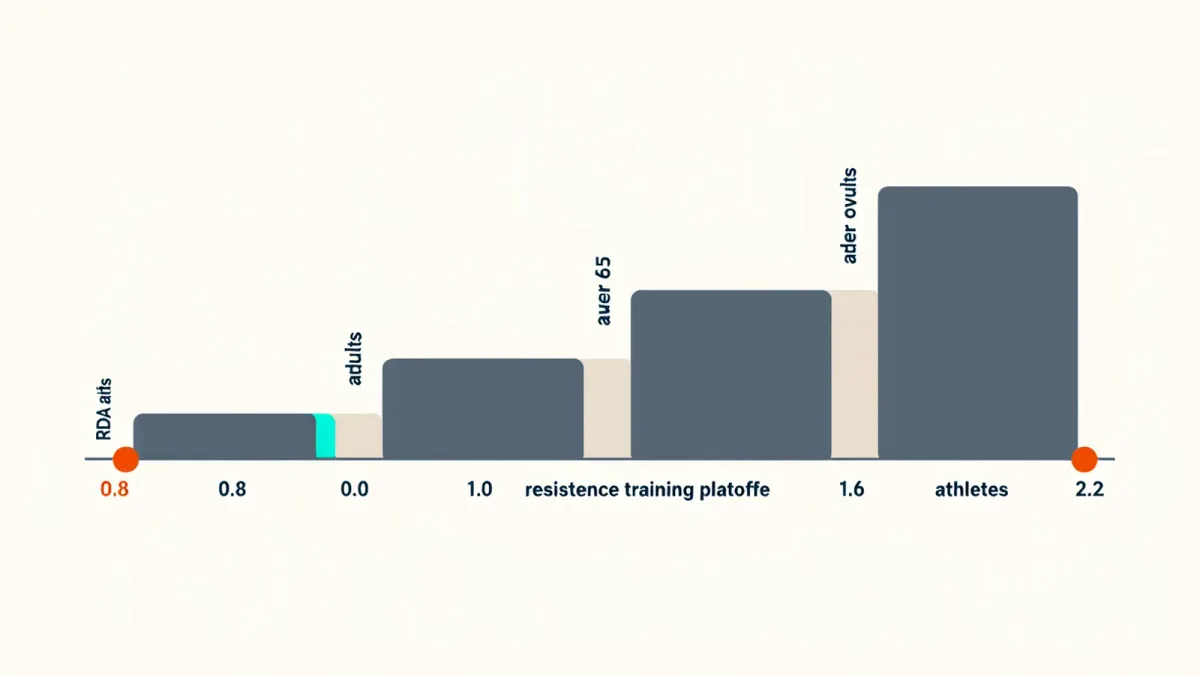
The official answer is 0.8 grams of protein per kilogram of body weight per day — 56 grams for a 70-kilogram adult man, 46 grams for a 57-kilogram woman — as the Recommended Dietary Allowance set by the National Academies' Dietary Reference Intakes in 2005. Trial evidence on muscle building points higher: a 2018 meta-analysis in the British Journal of Sports Medicine found resistance-training gains rose with intake up to about 1.6 grams per kilogram, then leveled off.
This site publishes information, not medical advice. Protein targets here are attributed research findings and official intake standards, not recommendations; readers with kidney disease, gout, or metabolic conditions should set intake with their own clinician, since protein restriction is part of treatment for some of them.
What exactly does the RDA cover?
The 0.8 grams per kilogram figure is a floor, not an optimum, in the reading its own authors give: the Recommended Dietary Allowance is defined as the intake meeting the needs of 97 to 98 percent of healthy adults, set to prevent deficiency, per the National Academies' Dietary Reference Intakes. It is not calibrated to maximize muscle mass, athletic performance, or recovery from illness. Most American adults clear it comfortably — federal survey data analyzed by the National Institutes of Health's Office of Dietary Supplements show average intakes well above the RDA for both sexes, meaning deficiency is rare in the general population.
How does the higher range differ, and who studied it?
The 2018 meta-analysis, by Morton and colleagues in the British Journal of Sports Medicine, pooled randomized trials of protein supplementation during resistance training and estimated that lean mass gains continued increasing as intake rose to roughly 1.6 grams per kilogram per day, with no meaningful additional benefit beyond about 2.2 grams. The gains in absolute terms were modest — on the order of a few hundred grams of additional lean mass over the study periods, which ran weeks to months. Work in older adults runs parallel: the PROT-AGE Study Group, an international panel publishing in the Journal of the American Geriatrics Society in 2013, concluded that adults over 65 may need roughly 1.0 to 1.2 grams per kilogram to preserve muscle during aging, a preliminary consensus rather than a formal federal revision.
Intake figures by authority
| Authority | Intake | Population | Year |
|---|---|---|---|
| National Academies DRI (RDA) | 0.8 g per kg body weight | Healthy adults | 2005 |
| PROT-AGE Study Group | About 1.0-1.2 g per kg | Adults over 65 | 2013 |
| British Journal of Sports Medicine meta-analysis | Benefit up to about 1.6 g per kg | Adults in resistance training | 2018 |
| Academy of Nutrition and Dietetics et al., position stand | 1.2-2.0 g per kg | Athletes | 2016 |
The spread is real but narrower than supplement marketing suggests: every named figure sits between 0.8 and 2.0 grams per kilogram, and the top of the range applies to specific populations — athletes in hard training, older adults fighting sarcopenia — not to the general reader.
Related stories: How much added sugar is too much, per the Dietary Guidelines and the heart association · How much water do you actually need, per the National Academies.
Does more protein mean more muscle without training?
No, per the trial record. The 2018 meta-analysis measured protein intake layered on resistance training; the training itself carried the stimulus, and protein modified the response. Trials comparing high-protein diets in sedentary adults have not shown lean mass gains approaching those in trained groups, and the 2018 analysis explicitly found intake above the plateau added nothing. In other words, the higher numbers are training adjacencies, not a reason to load protein onto an untrained body — a point the authors state plainly.
What about weight loss and satiety?
Protein's role in satiety and lean-mass preservation during calorie restriction is supported but modest in effect. Higher-protein diets preserve lean mass better during weight loss in randomized trials, and higher-protein meals rate higher on satiety in short-term feeding studies — findings summarized in the National Institutes of Health Office of Dietary Supplements' protein fact sheet. But head-to-head diet trials a year out show weight differences between protein levels shrinking substantially, and the fact sheet notes the long-term advantage is unclear. Preliminary is the honest label for any claim that a specific protein intake causes lasting weight change independent of calories.
The RDA prevents deficiency; the training studies measure response to exercise. Neither number is an order to eat more.
Can you get too much?
For healthy kidneys, trial evidence has not shown harm at intakes around 2 grams per kilogram in short- to medium-term studies, per reviews summarized by the Office of Dietary Supplements. The caution applies to diagnosed disease: chronic kidney disease management routinely involves protein modification under clinical supervision, and high-protein patterns can complicate it. Federal guidance puts no upper safety limit on protein itself but notes that very high intakes displace other foods and that supplement-based regimens can deliver doses far above any studied range — the Office of Dietary Supplements warns consumers off protein megadosing for exactly that reason.
What does this mean at the grocery store?
At 0.8 grams per kilogram, the RDA is reachable with ordinary food: a 70-kilogram adult needs 56 grams daily, and federal food-composition data put a chicken breast near 30 grams, a cup of lentils near 18, an egg near 6. The 1.6 gram figure from training research roughly doubles the arithmetic — and doubling protein intake usually doubles its cost, which is why the older-adult and athlete targets are where the research actually differs from the RDA, not in the general population. Readers changing intake around a medical condition, a training program, or a weight-loss plan are making a clinical decision and belong in a clinician's or dietitian's office first.
When to talk to a clinician
Anyone with kidney disease, a single functioning kidney, recurrent kidney stones, or gout should not raise protein intake without clinical input, because protein handling is directly involved in each condition. Older adults losing weight or muscle unintentionally, and adults starting resistance training with a muscle-building goal, are also better served by a dietitian's individualized calculation than by any population number printed here.