
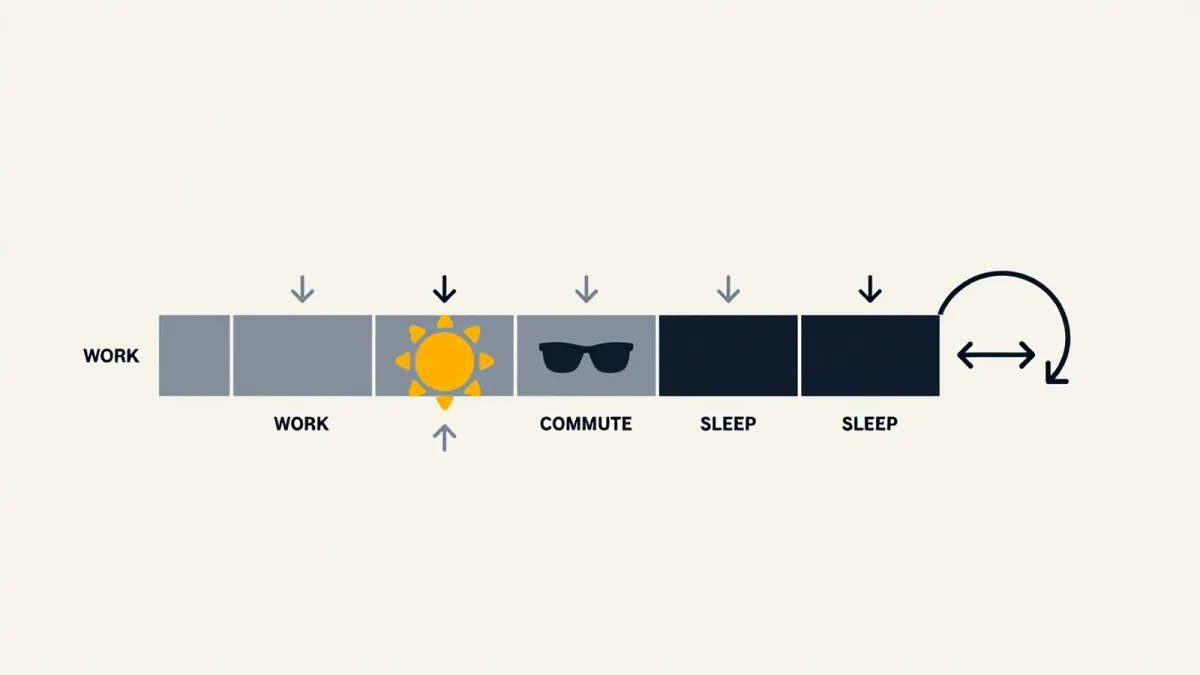
Light is the strongest signal the human circadian system responds to, and its timing decides whether a night shift helps or hurts: bright light during the night shift raises alertness and can shift the body clock toward a night schedule, while bright morning light after the shift blocks that shift and worsens daytime sleep. The National Institute for Occupational Safety and Health's training materials for shift workers treat light management as the most powerful individual lever available, and controlled studies since the 1990s — including Charles Czeisler's landmark 1989 work at Brigham and Women's Hospital showing bright light can fully re-entrain the human clock — anchor the mechanism.
This site publishes information, not medical advice. Light-box products and schedules interact with eye conditions and medications that increase photosensitivity, so workers considering therapeutic light should confirm the plan with a clinician.
How does light reach the body clock?
Specialized retinal cells, described in a 2002 Science paper by David Berson and colleagues, project directly to the brain's master clock in the hypothalamus and are most sensitive to short-wavelength blue light around 480 nanometers. Exposure in the biological evening or night delays the clock; exposure in the biological morning advances it. For a day worker this machinery aligns life automatically. For a night worker it is the problem: daylight on the commute home and household light all push the clock in the wrong direction while the worker tries to sleep through the day.
What has light intervention research shown?
Field studies of night workers have tested several protocols, with results that are promising but rarely dramatic:
- Czeisler and colleagues' 1989 controlled study, published in Sleep, showed scheduled bright light and darkness could shift temperature rhythms to align with night work — proof the adult clock adapts under the right conditions.
- Studies of blue-enriched office lighting during simulated and real night shifts, reviewed in journals including Sleep Medicine Reviews, report improved alertness and performance on shift, with effects on adaptation depending on whether workers then protected daytime darkness.
- A 2017 study by Anysia Pecor and colleagues in Occupational and Environmental Medicine tested a light intervention in hospital night-shift nurses and reported reduced sleepiness on shift — a single-site result, preliminary in scale.
The pattern across trials: light on shift works with the day, not instead of it. Bright night light followed by an unprotected commute home cancels most of the adaptation it built.
Related stories: Meal timing for night shift workers: what metabolic research shows · Naps for night shift workers: what the science says about timing and length.
What should a night worker actually do?
NIOSH's training materials distill the research into a schedule-aware sequence. On shift: seek bright light, ideally in the first hours of the shift, since that is when alertness bottoms out. On the commute home: sunglasses that block most light, because morning daylight is the strongest delay signal a night worker meets. At home: blackout sleep environment, as dark as the room can be made. On days off, the strategy splits — workers wanting full night adaptation keep some night light even off-shift; workers rotating back to days use days off to re-align with daytime. Which plan fits depends on the rotation, and persistent sleep disruption despite consistent execution is a sleep-medicine consult, not a willpower failure.
The clock-shift math in brief
Circadian phase shifts roughly an hour per day under ideal timed cues, per controlled laboratory protocols — slower in real-world conditions where stray light and meals fight the schedule. A permanent night worker aiming for full adaptation is committing to weeks of consistent light and dark timing. Rotating workers, by contrast, usually manage misalignment rather than eliminate it, which published reviews acknowledge as the realistic goal.
Does light carry any risks?
Nighttime light is associated with melatonin suppression, and observational studies have linked long-term night shift work to elevated risks of several diseases — the International Agency for Research on Cancer classified night shift work as probably carcinogenic to humans in 2007 and reaffirmed the classification in 2019, based on limited human evidence. Whether light management changes those long-term risks has not been demonstrated; trials measure alertness, sleep, and circadian phase, not cancer outcomes. The intervention evidence supports short-term function, and claims beyond that outrun the studies.
The same photons help on shift and hurt on the drive home; timing is the entire treatment.
What about light boxes sold for shift workers?
Fixed-time light boxes deliver the wavelengths and intensity trials used — typically 2,000 to 10,000 lux at set times — and product claims track that literature. What a purchase cannot supply is the schedule discipline the studies paired with exposure, or the darkness protocol afterward. Workers using light therapy devices for diagnosed conditions already have a prescriber; those self-treating should note that trial protocols differ from product marketing and confirm the plan with a clinician.
What does the workplace control versus the worker?
Employers own the lighting in most workplaces, which puts the strongest intervention partly outside the worker's hands. Published field studies of upgraded night-shift lighting — brighter, cooler overhead systems in hospitals, factories, and control rooms — required management cooperation and capital spending, and results depended on workers then protecting darkness at home, a condition the studies could not enforce. Labor agreements in some sectors address lighting quality directly; where they do not, an individual worker's most effective tools remain the cheap and portable ones — sunglasses for the commute, blackout solutions at home, a desk lamp with high output during the shift's low point.
The division of responsibility mirrors the evidence's own structure: the mechanism is personal and schedulable, but the environment is institutional. A worker executing every published light recommendation under a skylit break room and an unshaded commute is fighting the same photons the research deploys, and persistent symptoms under those conditions say more about the environment than about the worker's discipline — a framing worth carrying into any conversation with occupational health or a clinician.