
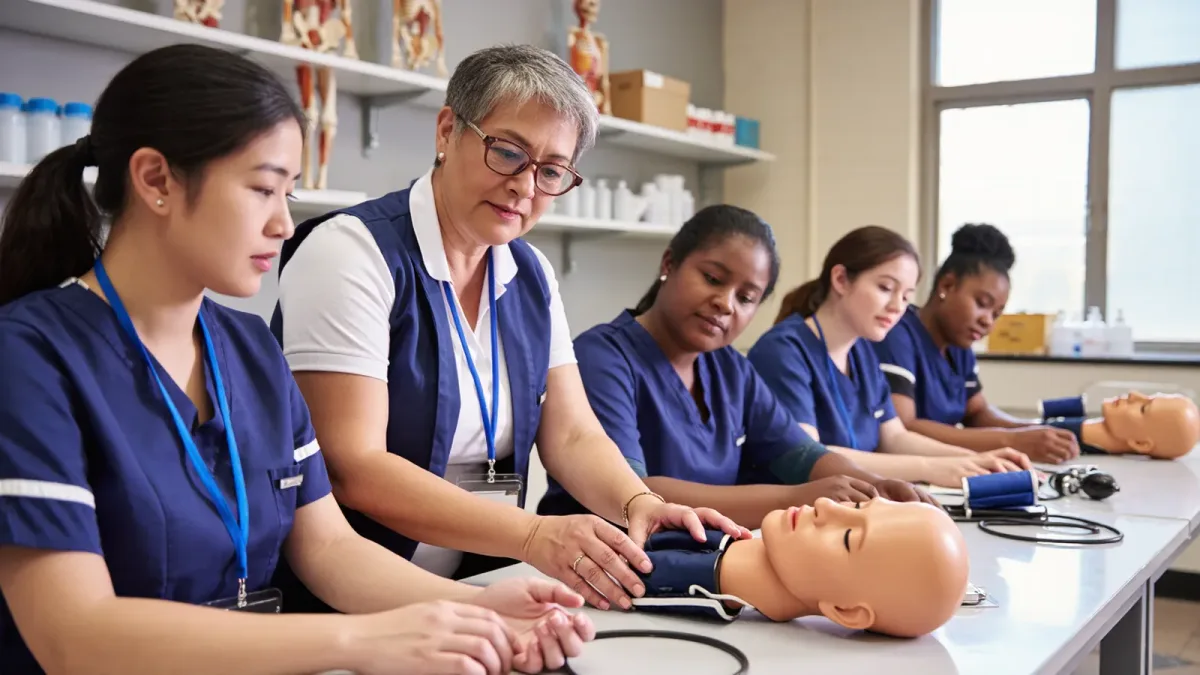
Becoming a licensed practical nurse in New York takes most candidates 12 to 18 months from first class to first shift. Full-time practical nursing certificate programs run roughly 10 to 12 months, and licensure requires passing the NCLEX-PN examination, per the New York State Education Department's requirements for practical nurses. Part-time and evening tracks stretch the classroom portion to 18 months or more.
Health Work NY publishes information, not career advice. The timelines and pay figures below come from the state licensing board and federal labor statistics, each named where it appears; anyone weighing the path should verify current requirements with the board itself before enrolling.
What does the licensing board actually require?
New York licenses practical nurses through the State Education Department's Office of the Professions. The statutory requirements are three, per NYSED's licensing description: completion of a state-approved practical nursing program or its equivalent, an age of at least 18 for full licensure, and a passing score on the National Council Licensure Examination for Practical Nurses, the NCLEX-PN. New York does not issue a provisional practice permit that lets graduates work before the exam, so the clock effectively stops until the license is issued.
The approved-program list matters. Graduates of programs approved by NYSED sit for the exam without an additional education review; graduates of out-of-state or foreign programs may face an education credential evaluation that adds weeks to months, according to the board's application materials. Checking a program's approved status on NYSED's roster before enrolling is the single cheapest schedule protection available.
How long is the program itself?
Most New York practical nursing programs are certificate programs at BOCES centers, community colleges, and private career schools, and the full-time versions run about 10 months to one academic year, with combined classroom and supervised clinical hours. Part-time and evening cohorts, common at BOCES adult-education programs, take 12 to 18 months. Admission requirements typically include a high school diploma or equivalency and an entrance exam such as the TEAS or a comparable test; waiting lists for cohort-based programs vary by region, and applicants should ask each school directly about current cohort start dates and seat availability, since the board does not publish waitlist data.
How fast does the license arrive after the exam?
The exam itself is scheduled through Pearson VUE, the testing vendor contracted by the National Council of State Boards of Nursing, and the exam fee is $200, per NCSBN's 2023 fee schedule. Candidates who pass and have a clean, complete application generally receive license issuance within a few weeks of the board's receipt of exam results; applications that trigger an education review or a professional-misconduct question take longer, per NYSED's own processing notes. Graduates who need income sooner sometimes work as certified nursing assistants while the license is pending — a legal stopgap, but one that extends the total transition by whatever hours the CNA job absorbs.
| Step | Typical duration |
|---|---|
| NYSED-approved practical nursing program, full-time | 10–12 months |
| Same, part-time or evening track | 12–18 months |
| NCLEX-PN scheduling and testing | 2–8 weeks after graduation |
| License issuance after complete application and pass | Several weeks, per NYSED |
Related stories: Physician assistant licensure in New York: the timeline from student to license · Radiologic technologist licensure in New York: a guide to the DOH process.
What does the job pay once licensed?
Licensed practical and licensed vocational nurses earned a national median of $59,730 per year in May 2023, according to the U.S. Bureau of Labor Statistics' Occupational Employment and Wage Statistics program. New York employment concentrates in nursing care facilities, home health services, and hospitals, and pay tracks setting and region; the federal figure is a national median, not a New York guarantee, and individual offers vary by employer and union contract.
Can the LPN license be a step toward registered nursing?
Yes, and the structure is well worn. LPN-to-RN bridge programs compress an associate-degree nursing curriculum for licensed practical nurses, typically running 12 to 24 months, and graduates sit for the NCLEX-RN. Registered nurses earned a national median of $86,070 per year in May 2023, per BLS — a wage gap of more than $26,000 at the median that explains why many practical nurses treat the LPN license as a first rung rather than a destination. The trade-off is that bridge programs carry the same cohort capacity limits as other nursing programs, so the waiting time for a seat can be the binding constraint, not the coursework.
What slows candidates down?
Three things recur, none of them clinical. First, enrolling in a program that turns out not to be NYSED-approved, which converts a finished certificate into an education review. Second, incomplete application paperwork, which the board returns rather than queues. Third, exam retakes: NCSBN limits candidates to five attempts on the NCLEX under its retake policy, and a failed attempt adds a mandatory wait of 45 days before retesting, per NCSBN's 2023 policy. None of these add clinical skill; all of them add calendar.
The licensed practical nurse is among the shortest licensed paths into patient care in New York — roughly a year of school for a credential the state requires before a single paid shift.
For candidates deciding between the LPN track and direct-entry registered nursing, the comparison is duration against ceiling: about 12 to 18 months and a $59,730 national median for the practical license, versus two to four years and an $86,070 national median for registered nursing, in both cases per BLS May 2023 data. Which trade wins depends on the candidate's finances and timeline, not on any ranking — and the board's own requirement pages, not this publication, are the controlling document on what each license takes.