
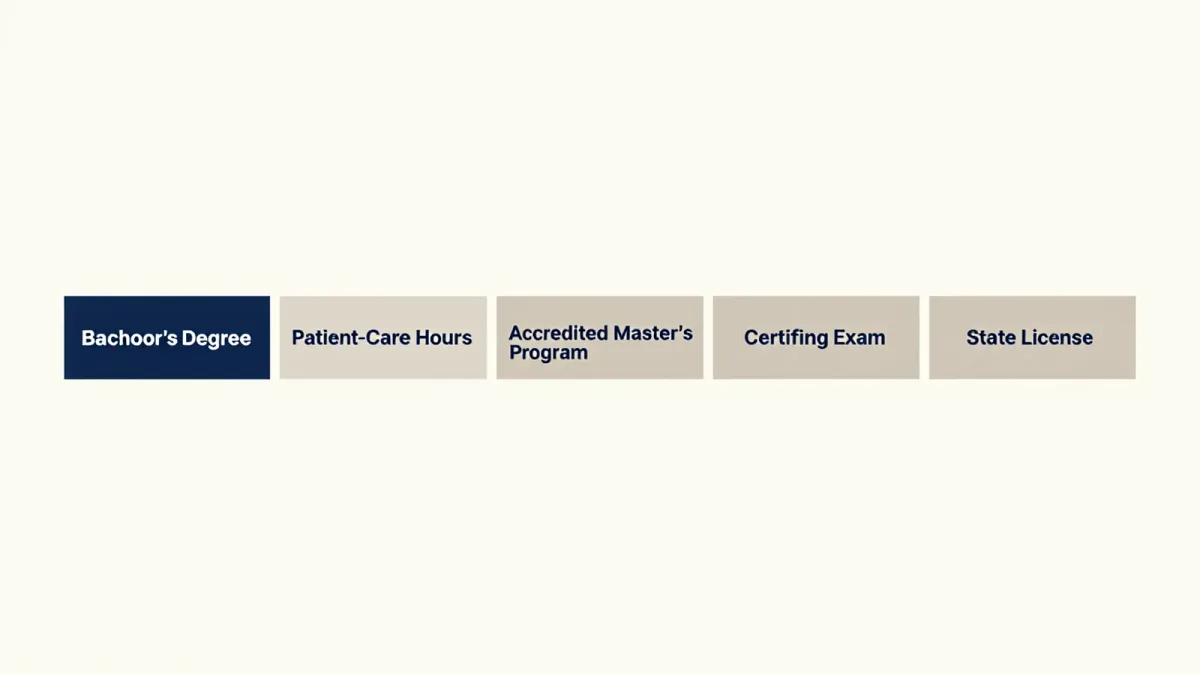
Becoming a licensed physician assistant in New York takes about six to seven years from the start of undergraduate study: a bachelor's degree and prerequisite coursework, a 24-to-33-month accredited PA program, the national PANCE examination, and licensure through the State Education Department. The wage at the end is documented — physician assistants earned a national median of $130,020 a year in May 2023, per the U.S. Bureau of Labor Statistics.
Health Work NY publishes information, not career advice. The timeline below is assembled from the state licensing board, the national credentialing body's published policies, and federal wage data, each named where it appears; applicants should confirm current requirements with the board, which controls.
What are the steps to a New York PA license?
The State Education Department requires four things, per its licensure description: graduation from a physician assistant program accredited by the Accreditation Review Commission on Education for the Physician Assistant, a passing score on the Physician Assistant National Certifying Examination, an application to the state with the required fees, and — for the practice agreement that governs PAs in New York — alignment with a supervising or collaborating physician structure under state law. New York amended its PA practice framework in recent legislative sessions to loosen certain supervision restrictions, per the bill history on the law; the license itself, however, remains a NYSED issuance with the same education and exam gate.
How long does each stage take?
The undergraduate stage typically runs four years, and PA programs expect healthcare patient-contact experience plus prerequisites in anatomy, physiology, microbiology, and chemistry — hours many applicants earn as CNAs, EMTs, or medical assistants, which stretches the pre-application stage by a year or more for those starting without clinical work. The accredited master's program itself runs 24 to 33 months, per ARC-PA program standards. The PANCE is scheduled after graduation through the National Commission on Certification of Physician Assistants, which reported in its published candidate materials that results are typically available within weeks of testing. NYSED license issuance follows a complete application.
| Stage | Typical duration |
|---|---|
| Bachelor's degree with prerequisites | 4 years |
| Patient-care hours before application | 1 to 2 years, applicant-dependent |
| ARC-PA accredited master's program | 24 to 33 months |
| PANCE scheduling, testing, license issuance | Roughly 2 to 3 months |
Related stories: Radiologic technologist licensure in New York: a guide to the DOH process · How long does it take to become an LPN in New York? The timeline, step by step.
What does the PANCE involve, and what if it takes more than one try?
The PANCE is a 300-item multiple-choice examination administered by NCCPA over five hours, per the certifying body's published handbook, with a first-attempt fee in the hundreds of dollars set by the organization. Candidates who fail may retest after a seven-day waiting period per NCCPA policy, with cumulative retake limits that the handbook details; a second failure imposes a longer mandatory wait. The stakes are structural: no PANCE pass, no state license, and New York does not permit practice in the interim. Applicants budgeting the final stage should treat the exam fee and the state application fee as separate line items, paid to two different bodies.
What does the license pay in New York?
Physician assistants earned a national median of $130,020 a year in May 2023, according to the Bureau of Labor Statistics' Occupational Employment and Wage Statistics, and the bureau's New York metropolitan tables place local pay above the national median. Hospitals employ the largest share of PAs, per the bureau's industry data, with surgical, emergency, and inpatient teams competing for experienced clinicians. The bureau's long-term employment projections show the occupation among the faster-growing nationally — a sourced projection from the issuing agency, not this publication's forecast, and one based on healthcare demand trends rather than any single employer's plans.
The PA path is the longest of New York's mid-level clinical licenses — but its six-to-seven-year run buys a six-figure median wage in the federal May 2023 tables.
How does the PA timeline compare with nursing routes?
The comparison is duration against flexibility. An associate-degree registered nurse reaches licensure in roughly two years against the PA's six to seven, and the RN median of $86,070 in the same May 2023 federal tables trails the PA median by about $44,000. Nurse practitioner, the nursing route to prescriptive practice, adds a master's to the RN license. Candidates who already hold a bachelor's degree in another field find PA programs' central application system accommodates career changers directly, while the nursing route to comparable authority runs through accelerated BSN and MSN tracks. Neither path is faster in the abstract; the candidate's existing degree and clinical hours decide.
What catches applicants out?
Three recurring delays, none clinical. First, insufficient documented patient-care hours at application time — the requirement programs set individually, published in each program's admissions materials. Second, prerequisite courses taken years earlier that a target program no longer accepts without retaking, per the same materials. Third, assuming the national certification replaces the state license: it does not, and NCCPA certification and NYSED licensure are separate processes with separate fees. Applicants who map all three requirements against their own transcript before applying save semesters.